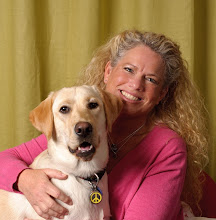
As far as I know, no one has called or stopped by asking about her, so I guess it is safe to spill the beans. Remember Sunshine, the poor Basset Hound that was tied up to our picnic bench one afternoon, no note or ID tags-nothing? The dog that got my blood boiling about loser humans... Well, she is doing just fine-more than fine, actually. She is going to have one terrific life now, thanks to Chance and Phoebe's owners, two other Basset friends of ours. Of course we thought of them when we met Sunshine-they are some of the best humans we know, going above and beyond in their care for their furry family members, especially their "special needs" children. When we called to see if they could foster this abandoned dog while we decided what to do about her, they didn't even hesitate, saying of course, and instantly offering to adopt her before they even met her! Of course we wanted it to be OK with Chance and Phoebe, so we sent her home for a test run over that first weekend-and everything worked out perfectly. Her name is now Lilly-it really suits her. She is sleeping on the couch with the rest of the family and her once reserved/shy personality is no longer; she has really blossomed with the love and security of her new home and wonderful family. She is in a forever home, and we couldn't be happier for her. OK, there ARE good humans out there!
We got to see Lilly today for her spay and some much needed dental work-she had some infected gums and diseased teeth that were likely causing her some pain. We took some dental x-rays, extracted the bad teeth, cleaned up the others and will get her started on some preventive dental care when she goes home. She actually had a big abscessed tooth and will get some antibiotics, definitely not a routine part of dental work.
I thought I'd take this opportunity to explain just what a "spay" procedure entails. We hear about them all the time, but few people actually know what is involved in the surgery for an individual animal. We talked a little about it in the blog "There's No Such Thing As A Routine Spay." The term "neuter" is traditionally used to refer to the surgery to sterilize male dogs or cats-technically a castration procedure. But a neutered animal can be either a male or female animal who has been altered; it is just more common to refer to the female surgery as a "spay."
Different veterinarians may do the procedure differently; ligating and removing ovaries only-an ovarioectomy, or the much more common removal of both ovaries and uterus-an ovariohysterectomy. Some veterinarians, particularly those trained in Europe, prefer to perform the procedure through a flank approach into the abdomen-on the side of the animal just behind the ribs and in front of the pelvis but below the thick spinal muscles. It is more common to find
 American animals spayed through a ventral midline incision-a line made from near the umbilicus or belly button down towards the pelvis on the underside of the belly. These incisons are traditionally very short. This can be an unsafe habit for a surgeon to get into, as visualization of important liagures is impossible from one of these keyhole incisions. Owners undoubtedly like smaller incisions, but if the reason for longer ones is explained, few will complain. Besides, incisions heal from side to side, not top to bottom. A 3 inch line will heal just as quickly as a 1 inch one!
 After the initial incision is made into the abdomen, some fatty tissue may need to be removed for better visualization. No, this isn't liposuction! We simply cut away any excess fat that has been deposited in our line of sight, making it much easier to see the organs and ligatures we will make.
Have I mentioned before how important visualization is? We are dealing with very precious patients and spays are major surgeries for these girls. I suppose some veterinarians are adept at the "Braille" method after doing hundreds and hundreds of these procedures; I for one want to be sure I really know which organs I am removing, which vessels I am tying off, which ones I am cutting, and being able to SEE these is the only way for me to be certain.
 The next step is to exteriorize one side of the uterus. Unlike humans, dogs and cats have uterine horns-2 long sides and a short body designed to hold multiple fetuses-humans just aren't designed to have litters. We use a special instrument called a spay hook or snook hook to fish the first horn free from the rest of the abdominal contents, definitely relying on feel and knowledge of normal anatomy to know where to look for it. It can be very small in even a very large dog if she has never had a heat cycle yet-there has been no estrogen influence on the organ and therefore no reason for it to develop. It can literally get lost amoung all those other organs, intestines, omentum and such. Sometimes just finding it is the hardest part of the surgeery!
 I then bring out the ovary which is located at the end of this uterine horn, often hidden within more fatty tissue. It is usually located near the kidney up against the back of the body, attached with a ligament that can be broken down with a "strumming" of the finger. I rarely cut these with scissors or scalpel blades, although that ligament can be quite tight in young dogs. I like to place clamps and ligate blood vessels supplying the ovarian "stump" with a type of suture material that will slowly absorb on its own. Suture material that is too slick may slip off the vessels or stump or may not produce a secure knot. Surgeons develop their own preferences for suture materials in various circumstances.
 The procedure is repeated for the other side, but you don't have to search for that one-you can just follow the horn down to the bifurcation at the uterine body, then over to the other side. The uterine stump is then ligated near the cervix, often with a transfixation ligature. This means that the suture material is passed through the organ to attach to it in one or more places, making it less likely to slip off after tightening down on it. All three sites (both ovarian and one uterine) are checked carefully for bleeding and then we can close up the midline incision.
 Closures of the incsion vary with the surgeon. I generally close in two layers-the linea and the subcuticular layers. The linea is the thin white line, anotomically called the linea alba, that runs the entire length of the midline and is the connective tissue junction of the two sides of the body. Since there is no muscle tissue here, the closures involving this tissue is less apt to swell, is less vascular and seems a more comfortable closure. I believe animals tend to lick or chew less when muscle isn't incorporated in this layer. The subcuticular layer is basically under the skin or within the skin; I like closing without visible stiches outside the skin to again discourage pets from bothering the incision. It also seems to make for a more cosmetic appearance to the skin closure.
  These also absorb slowly over time. Sometimes I need to apply a drop or two of tissue adhesive or skin "glue," particularly over suture knots to ensure skin completely covers the suture material. On the rare pet in which I use skin sutures, I will place a few non-absorbably sutures or even surgical staples across the incision. Some videos of the actual spay (and castration) surgery are found here: Shelter Surgeries
Pets are sent home with pain relief medications to allow for a comfortable recovery period-about 7 - 14 days. They often need to wear e-collars or the silly satellite dishes or cones around their necks to prevent the licking or chewing that can occur with even the best dog when they are unsupervised. It is extremely rare for these girls to need antibiotics unless there is a pyometra or literally pus in the uterus. We like to see the patients about 1 week after surgery to be sure they are healing properly and to answer any questions an owner might have about their care.
Spays are a very important part of any veterinary practice. Unspayed females are at a much greater risk of mammary cancers and pyometra, as well as contributers to the problem of pet over-population. While definitely not routine for the individual animal, it is a "rite of passage" for a young female dog. Lilly is currently snoozing away, comfortable in her warm kennel and having received her pain medications for the evening. She ate a small meal and walked outside earlier; I'm pretty sure she will do well tonight and get to go home to her wonderful new home first thing tomorrow. Such a happy ending for such a happy girl.
Peace,
DrReneigh